Doing more with less in frontline hiring: where the pressure is coming from and what to do about it

Frontline TA teams have been told to do more with less for long enough that the phrase has lost its meaning. It's become background noise. A thing that's said in budget meetings and then absorbed as just another condition of the job.
The problem is that the underlying pressure is real, and it's getting more specific. It's no longer just a headcount conversation. The expectation has shifted to: hire faster, screen better, improve the candidate experience, reduce cost per hire, and do all of it with a team that in many organisations is smaller than it was three years ago.
According to data from payroll company Ramp, the ratio of TA professionals per hundred employees dropped from 1.8 in 2022 to 1.2 in 2025. So the workload has grown more complex at exactly the moment that capacity has shrunk.
Understanding why this is happening, and where the gaps actually sit, is more useful than any generic advice about working smarter.
Three forces that are making frontline hiring harder right now
The Gen Z expectation gap
Within three years, a third of the talent pool in Europe and the US will be from Gen Z. In sectors like hospitality, retail, and logistics, they're already the majority of applicants.
This matters because Gen Z's relationship with technology is structurally different from previous generations. They didn't adapt to mobile. Mobile is their default. They expect the application experience to be immediate, seamless, and native to how they already use their phones. A careers page that requires a desktop form submission and a 48-hour wait for an acknowledgement isn't a minor inconvenience to this cohort. It's a signal that the employer isn't worth the effort, and there's usually another option a screen away.
The organisations that have already built their application processes around mobile-first, fast-response workflows are not ahead of a future trend. They're already operating in the present that everyone else is catching up to.
A shrinking talent pool
Europe is already short roughly four million workers across frontline industries, and that gap is growing with an ageing population. The competition for available talent is more acute than many organisations are willing to say out loud in planning documents, but it shows up clearly in time-to-fill numbers and offer decline rates.
The practical implication is that the cost of a slow or friction-heavy hiring process is higher than it used to be. Candidates who drop out of your funnel because you took too long to respond aren't going to another role on your careers page. They're accepting an offer from a competitor. Read more about how hiring speed directly affects talent outcomes in our piece on why slow hiring is costing you the best talent.
AI-generated applications are making screening harder
The signal-to-noise problem in high-volume screening has always been difficult. It's now getting dramatically worse. Most TA leaders running volume hiring are seeing the same thing: applications that are polished, well-structured, and nearly indistinguishable from each other, because a growing proportion of candidates are using AI tools to write them.
A CV or cover letter that would have stood out two years ago is table stakes today. The traditional markers of a strong application, clear structure, specific language, relevant framing, are now reproducible by anyone with access to a free tool. That means the screening methods built around reading applications closely are losing their effectiveness. The ability to extract meaningful signal from written materials at volume is genuinely harder than it was, and this trend accelerates as AI tools improve and become more widespread.
For teams still relying heavily on CV review as their primary screening mechanism, this is a significant structural problem. For context on why CV-based screening was already showing cracks before AI entered the picture, see our piece on why CVs don't work for high-volume staffing.
Where the gaps accumulate
The temptation when facing this kind of pressure is to look for the single biggest problem and fix it. In practice, frontline hiring rarely breaks down that way. The damage comes from an accumulation of smaller inefficiencies across the funnel. Each one is manageable on its own. Together, they erode quality, speed, and candidate experience in ways that are hard to attribute to any single cause.
Admin overload
As application volumes rise and quality differentiation drops, recruiters spend more time on tasks that require effort but not judgement. Reviewing applications that look identical. Sending the same first-touch emails. Scheduling calls and chasing responses. These tasks consume hours that could go toward the parts of the job that actually benefit from a recruiter's experience.
The compounding issue is that this isn't just a productivity problem. When recruiters are spending most of their time on administrative processing, the quality of the assessments they do make tends to fall. There's a practical ceiling to how many application screens a person can do before their judgement degrades. Most high-volume TA teams are operating above that ceiling routinely. The full financial picture of this is worth examining: our breakdown of the true cost of manual screening puts numbers to what most TA leaders already sense.
Inconsistency in decentralised organisations
For retail chains, hospitality groups, and logistics operators running hiring across dozens or hundreds of sites, the central TA team sets the process but local managers run it. The result is that screening standards, candidate communication quality, and interview rigour vary enormously across the organisation. The central team has no visibility into most of it, and the costs sit in local P&Ls where HR can't reach them.
This isn't a failure of local managers. It's a structural problem. Asking a store manager who's also responsible for staff rotas, stock management, and customer operations to run a consistently high-quality hiring process is unrealistic without tooling that takes most of the execution off their plate.
The organisations that are solving this are the ones bringing more of the process back under central control, using automation to own the early stages of screening across every location while keeping local managers in the decision loop. This is explored further in our piece on what it really takes to hire at scale in hospitality.
Recruiter churn at the worst moments
Turnover in frontline TA roles is consistently higher than in other functions, and the timing is rarely convenient. Losing an experienced recruiter during peak hiring season is a compounding problem: the institutional knowledge leaves, the remaining team absorbs the extra load, and the quality of hiring decisions drops at exactly the moment when volume demands are highest.
This is partly a capacity problem and partly a quality-of-work problem. Recruiters who spend the majority of their time on repetitive processing rather than on work that uses their skills are more likely to burn out and leave. Reducing that administrative load isn't just an efficiency question. It's a retention question.
The diagnostic framework that actually helps
Before reaching for solutions, the more useful exercise is a structured assessment of where pressure is concentrated in your specific funnel. Four areas are worth examining systematically.
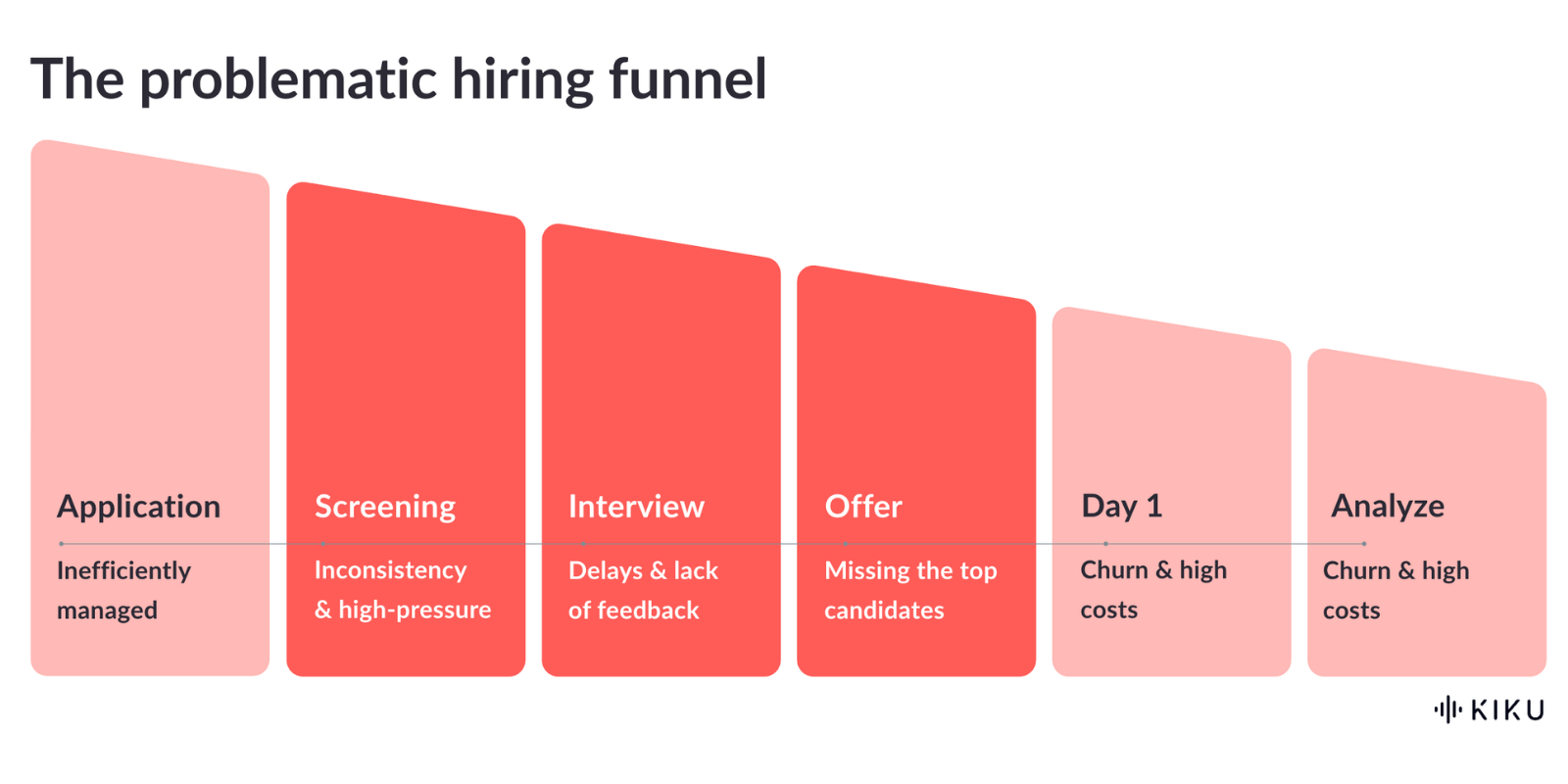
Funnel health covers where candidates are dropping out, where processing slows down, and whether the attrition in your pipeline reflects genuine disqualification or friction you've inadvertently created.
Team capacity looks at how recruiter time is actually allocated across tasks, and whether that allocation matches where human judgement creates most value. Most teams, when they map this honestly, find that a disproportionate share of hours is going to tasks that don't require a recruiter's skill.
Cost structure goes beyond direct hiring cost to include vacancy cost: the revenue and operational impact of an unfilled frontline role. In hospitality and retail, this is often the largest single number in the hiring cost picture and the one that's most systematically ignored, because it doesn't sit in the HR budget.
Process consistency asks how reliably your hiring process runs the same way across roles, sites, and hiring managers, and whether the variation you're seeing in outcomes is explained by genuine candidate quality differences or by inconsistency in how people are assessed.
Most TA teams, under cost pressure, default to scrutinising the cost line. The biggest opportunities are usually in the other three areas.
Prioritising what to fix first
Once you've done the diagnostic, the sequencing question is: what has the highest impact and is the most tractable to fix right now?
Two things tend to land in the high-impact, easier-to-fix category for most high-volume teams.
Structured screening at volume. Replacing or supplementing CV review with consistent, structured questions that are assessed the same way for every candidate addresses the signal problem directly. It also makes the screening process fairer, which matters increasingly from a regulatory standpoint. For a detailed look at how bias creeps into screening and how to counter it, see our piece on four types of bias in screening processes.
Unstructured data analysis. The questions candidates ask most frequently in early interviews, what they find unclear about your process, how quickly they expect to receive an offer: all of this is already sitting in your hiring data. Making sense of it at volume used to require significant investment. With AI, it's now accessible to teams of any size, and the insights it surfaces tend to drive faster process improvements than most other interventions.
Employer brand sits in a different category: high impact, much harder to fix quickly. It's shaped by candidate perception and word of mouth, built through consistent experience over time. You can't solve it with a tool deployment. You build it through every interaction your process creates, which is a reason to fix the process first.
Where AI belongs in this picture
There's a version of AI adoption in frontline hiring that's just a headcount substitution argument: automate tasks, cut recruiters, reduce cost. That version misses the point.
The more useful frame is bandwidth. If AI handles the high-volume, repetitive stages of the funnel, recruiter time gets redirected to the work that genuinely benefits from human involvement: complex assessments, internal mobility conversations, offer negotiation, building hiring manager relationships. The parts of the job that have always needed more attention than they get, precisely because teams have been maxed out processing volume.
The distinction matters for how you evaluate and implement AI tools. A tool that processes applications faster is useful. A tool that gives your recruiters back the capacity to do better work is a different kind of investment. Our roundup of the best AI recruiting tools for 2026 breaks down what's available and where different tools are most effective.
For teams working through vendor evaluation under EU AI Act requirements, which now apply to any AI system used in hiring decisions, our guide to evaluating AI recruiting vendors for compliance covers the questions worth asking before you commit.
The practical starting point
The organisations that are navigating this well aren't necessarily the ones with the biggest budgets or the most sophisticated tech stacks. They're the ones that started with an honest assessment of where their process was breaking down, sequenced their interventions accordingly, and built internal support by showing early, measurable impact.
Doing more with less becomes a tractable problem when you treat it as a diagnostic challenge rather than a capacity one. The question to answer is: what, specifically, is causing the gaps between the volume of hiring you need to do and the quality of outcomes you're getting? The answer almost always points to a set of specific, fixable things. Fix the right ones first.
.png)